How to Tune a PID Loop: A Field Guide

Hands-on · Process & motion control · ~12 min read
Every working controller you've ever liked (the oven that holds ±2°C, the axis that settles without a wiggle) is a PID loop somebody tuned well. This is the procedure we actually use in the field: how to prepare the loop, three tuning methods that work, the implementation details that silently decide whether your gains mean anything, and a symptom table for when it misbehaves.
PID tuning has a strange reputation: everyone learns the theory, yet most loops in industry run on defaults, folklore, or gains copied from the last machine. The result is everywhere, ovens that overshoot for ten minutes, axes that buzz, flows that cycle forever. None of that is the algorithm's fault. A PID has three knobs; tuning is the discipline of setting them deliberately instead of hopefully.
0 · The thirty-second refresher
The controller computes an actuation u from the error e = setpoint − measurement:
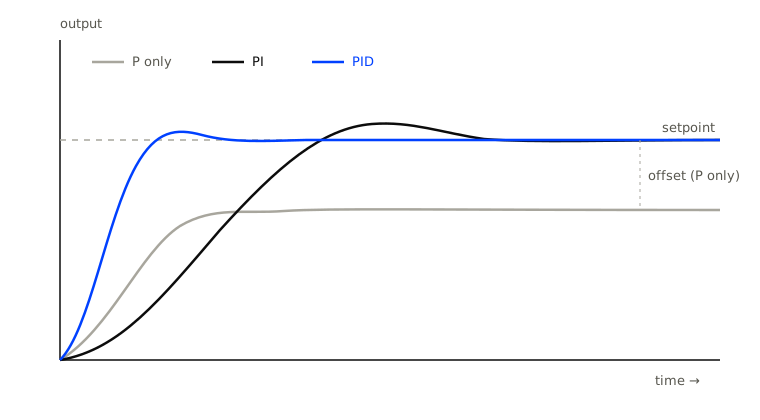
Each term has a personality, and you can diagnose most loops just by knowing them:
| Term | What it does | Too much of it |
|---|---|---|
| P: proportional | Reacts to the error you have right now | Oscillation; never quite reaches the target alone |
| I: integral | Accumulates leftover error until it's gone; kills steady-state offset | Slow cycling, overshoot, windup after saturation |
| D: derivative | Reacts to the rate of change; brakes before the target | Amplifies noise into actuator buzz and heat |
Vendors write the same controller in different parameterizations, parallel (K_p, K_i, K_d), standard/ISA (K_p, T_i, T_d), sometimes "gain + reset rate". Before you type any number into a drive or PLC, check which form it expects:
Mixing up the two forms is the single most common reason "textbook gains" fail in a real device.
1 · Before you touch a gain
Twenty minutes of preparation saves a day of frustration. In order:
- Fix the sample time. The loop must run at a fixed, known interval, jitter in Δt is noise injected straight into the I and D terms. Rule of thumb: sample at least 10× faster than the closed-loop response you want; for motor current loops that means tens of microseconds, for a thermal process one second is often plenty.
- Check the actuator and the sensor first. A sticky valve, an undersized heater, a 14-bit ADC measuring a 0.01% effect, no gain set fixes hardware that can't do the job. Step the output manually (open loop) and watch: does the process respond monotonically? How much delay before anything happens? How noisy is the measurement?
- Know your process type. Self-regulating processes (flow, temperature, current) settle at a new value after an open-loop step. Integrating processes (position from a velocity command, tank level) ramp until you stop them. The methods below assume self-regulating; integrating processes use different rules, and most motion loops are exactly that, which is why drive vendors ship their own tuning tools.
- Decide what "good" means. Disturbance rejection (hold temperature against door openings) and setpoint tracking (follow a profile) pull the tuning in different directions. Fast-with-overshoot or slow-and-certain is a requirement, not an afterthought.
2 · Method A: the manual recipe (works on almost anything)
No model, no math, safe if you go gently. This is the field workhorse:
- Set K_i = 0, K_d = 0. Start K_p low.
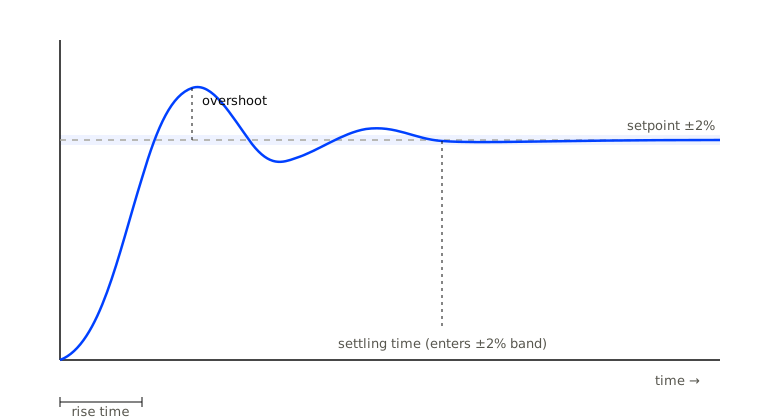
- Apply small setpoint steps (5-10% of range). Double K_p until the response overshoots slightly and rings for two or three cycles, then back off ~50%. You now have a P-only loop that responds briskly but won't quite reach the setpoint, the leftover gap is what the integral is for.
- Add integral: start T_i around the process's apparent time constant (the time the open-loop step needed to cover ~63% of its change). Halve T_i until the offset disappears at a pace you like; if slow oscillation appears, you've gone too far, back off.
- Add derivative only if you need it, to brake overshoot on a sluggish thermal mass, or to stiffen a motion axis. Start T_d ≈ T_i/4 and increase carefully. The moment the actuator starts buzzing, you've found your noise limit; back off and add measurement filtering (§4).
- Re-test with the real disturbances (door openings, load changes, direction reversals), not just pretty setpoint steps.
Tune for the disturbance you fear, not for the demo you'll show.
3 · Method B: Ziegler-Nichols, used honestly
The classic from 1942: it gives you a starting point in two measurements, and it's worth knowing both for its usefulness and its limits. Procedure (closed-loop version): with I and D off, raise K_p until the loop oscillates with constant amplitude. That gain is the ultimate gain K_u; the oscillation period is T_u. Then:
| Controller | Kp | Ti | Td |
|---|---|---|---|
| P only | 0.50 · Ku | n/a | n/a |
| PI | 0.45 · Ku | Tu / 1.2 | n/a |
| PID | 0.60 · Ku | Tu / 2 | Tu / 8 |
Two honest caveats. First, you must be allowed to oscillate the process: fine on a test rig, unacceptable on a live reactor or a loaded crane. Second, Z-N deliberately targets quarter-amplitude damping: each overshoot is a quarter of the previous one. That's aggressive: fast disturbance rejection, but oscillatory and not robust if the process drifts. Treat the table as a starting point and expect to cut K_p by 30-50% for production. For lifting heavy scenery over an audience, we never leave gains at Z-N values.
4 · Method C: lambda / IMC, when you can model the process
For process loops (temperature, flow, pressure), one open-loop step test gives you a first-order-plus-dead-time model, and with it, tuning where you choose the closed-loop speed instead of inheriting whatever the rules produce:
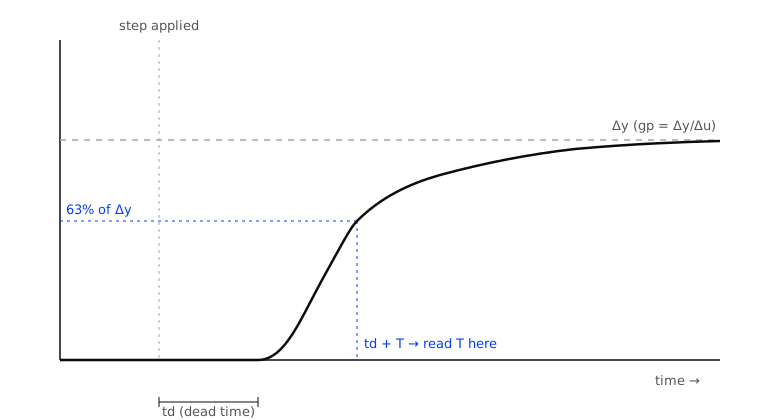
Pick a desired closed-loop time constant λ, slower λ buys robustness, faster λ buys speed. A common conservative choice is λ = 3T; never choose λ smaller than the dead time. Then for a PI controller:
This is the method behind calm, non-oscillatory process control, and because λ is explicit, "make this loop twice as gentle" becomes a one-line change instead of a re-tuning session. It's the family of rules we used to hold a 12-blower industrial oven at ±2°C: four coupled loops, where Ziegler-Nichols-style aggression would have had them fighting each other.
5 · The implementation details that make or break it
Here is the uncomfortable truth: most "tuning problems" are implementation problems. The four that matter, in one annotated loop:
// dt fixed, called at a constant rate
float pid_step(float setpoint, float y) {
    float e = setpoint - y;

    // (1) Integrate with clamping anti-windup:
    //     stop integrating in the direction that's already saturated
    integ += Ki * e * dt;
    integ = clamp(integ, u_min, u_max);

    // (2) Derivative on MEASUREMENT, not on error:
    //     a setpoint step then causes no output spike ("derivative kick")
    // (3) ...and low-pass filter it: raw derivative amplifies ADC noise
    float dy   = (y - y_prev) / dt;
    d_filt    += (dy - d_filt) * (dt / (dt + Tf));   // Tf ≈ Td/8 to Td/10
    y_prev     = y;

    float u = Kp * e + integ - Kd * d_filt;

    // (4) Respect the actuator's limits explicitly
    return clamp(u, u_min, u_max);
}
- Anti-windup (1). When the actuator saturates (heater at 100%, drive at current limit), a naive integral keeps accumulating, and you pay for it later as a huge overshoot. Clamp the integrator (or use back-calculation). This is the #1 real-world PID bug.
- Derivative kick (2). Differentiating the error turns every setpoint change into an output spike. Differentiate the measurement instead, same damping, no kick.
- Derivative filtering (3). An unfiltered D-term is a noise amplifier. Filter it; an unfiltered derivative is the buzzing sound your servo makes.
- Saturation honesty (4). The controller should always know what the actuator actually did. If you ever switch modes (manual to auto), initialize the integrator so the output doesn't jump, bumpless transfer.
6 · The symptom table
Tape this to the cabinet:
| Symptom | Likely cause | First move |
|---|---|---|
| Steady offset, never closes | No / too little integral | Decrease Ti (more integral) |
| Slow, large-period cycling | Too much integral | Increase Ti; check valve stiction |
| Fast oscillation around setpoint | Too much proportional | Cut Kp by half, retune |
| Actuator buzzes, runs hot | Unfiltered / excessive derivative | Filter D; reduce Td; check sensor noise |
| Huge overshoot after saturation | Integrator windup | Add clamping / back-calculation anti-windup |
| Overshoot only on setpoint changes | Derivative (or P) acting on error | Derivative on measurement; setpoint ramping |
| Great on the bench, drifts on the line | Process changed (load, temperature, wear) | Re-identify; consider gain scheduling |
7 · When PID isn't the answer
PID with these practices covers an enormous share of industrial control, but not everything. Strongly coupled multi-axis dynamics, pose-dependent inertia, contact tasks: there the right move is model-based control with PID-class loops inside it: the architecture we walked through in What It Really Takes to Make a Robot Move Precisely. And in motor control, the current loops living deepest inside Field-Oriented Control are themselves PI controllers, tuned analytically from the motor's R and L. That one deserves its own hands-on article (coming next).
Need a loop tuned: or forty?
Tuning one PID is a craft; commissioning dozens of interacting loops on real machinery (ovens, rigging, motor drives) is our day job at Segev Technologies. If your process cycles, your axis rings, or your controller "worked in simulation": let's talk.
Grounded in: J. G. Ziegler & N. B. Nichols, "Optimum Settings for Automatic Controllers," Trans. ASME, 1942; K. J. Åström & R. M. Murray, Feedback Systems (free online edition), ch. 11; lambda/IMC tuning rules as summarized by OptiControls; implementation practices popularized by B. Beauregard's "Improving the Beginner's PID" series.